
How Many Colours Do You Need to Colour a Map?
Today I was jumping between the thousand open tabs on my browser, checking Flixbus timetables, hostels on Hostelworld, trains… (Because the urge to escape from everyday life and its problems is always there.) I ended up on the Interrail website. In case you don’t know what it is: it’s a pass that lets you hop on trains and ferries across Europe, travel with a backpack, and meet a bunch of people in hostels. Very good, highly recommend.
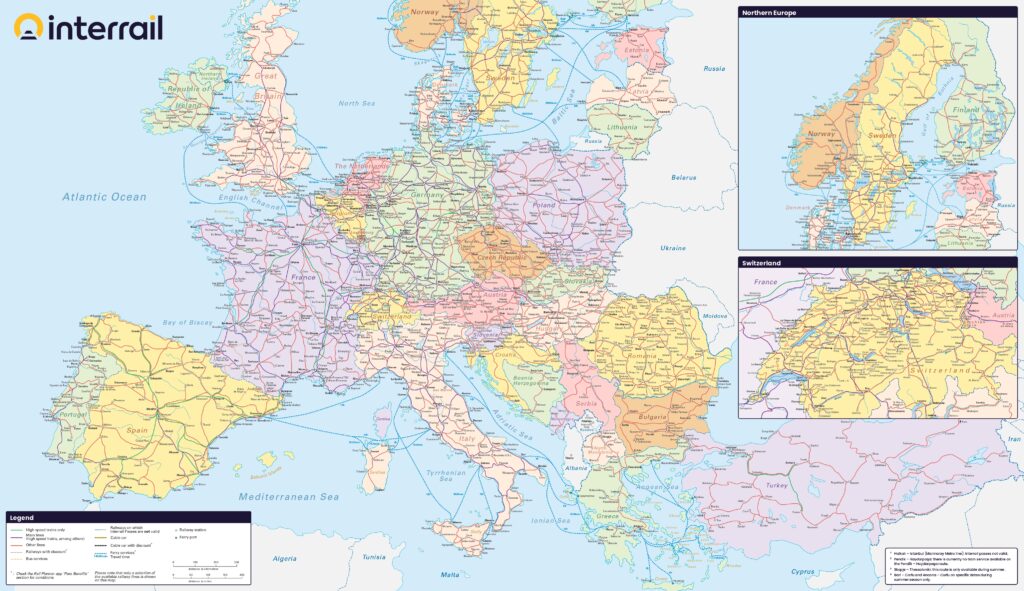
So there I was, staring at this map of Europe with all the railway routes, when I noticed they’d used six different colours to colour the various countries. I smiled and thought: why six, of all numbers? If someone wanted to colour a map using the minimum number of colours so that no two adjacent regions share the same colour — how many would they actually need?
I asked my dad out of curiosity, and this is what he said… Maybe because at that hour he’s usually already in REM sleep? I don’t know… what do you think? Try it!
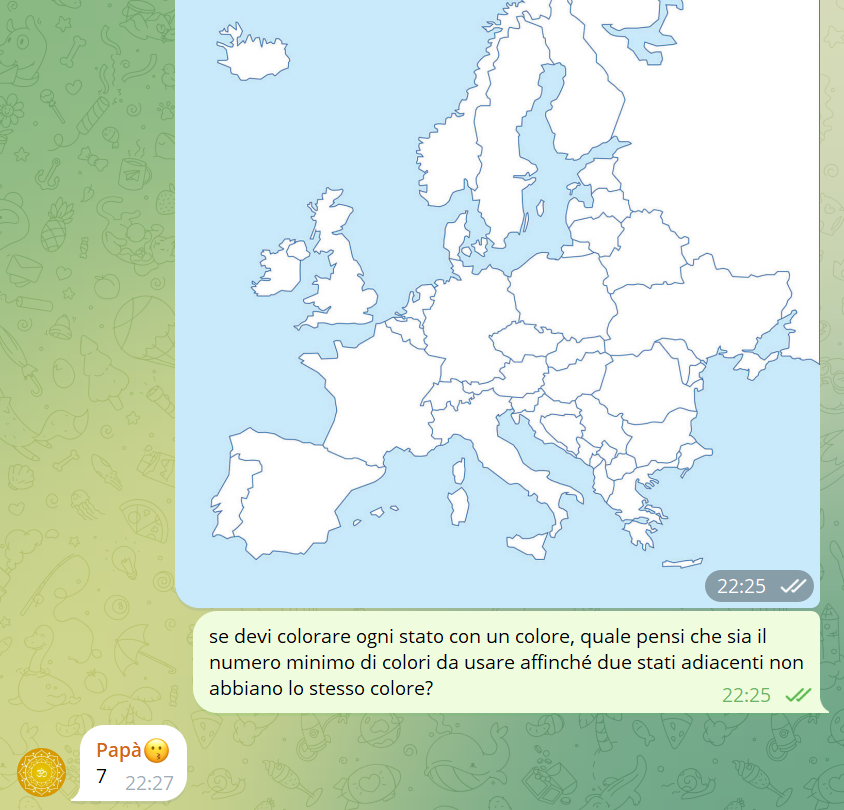
Here’s the thing: there’s a theorem in mathematics called the Four Colour Theorem, and it says you never need more than four colours to colour any map so that no two adjacent regions share the same colour. Four. Not five, not ten — four, no matter how twisted and complicated the map gets. I find this kind of beautiful, actually. The fact that something so visually chaotic — a map of a whole continent — obeys such a clean, absolute rule.
The conjecture goes back to the 1800s, when Francis Guthrie — mathematician and botanist, which is already a fun combination — noticed it while colouring a map of the regions of England. For over a century, people proposed proofs that turned out to be wrong. Then in 1976, Kenneth Appel and Wolfgang Haken claimed they’d finally proved it — with the help of a computer.
And this is where it gets interesting to me, personally. Some mathematicians refused to accept the proof, precisely because it came from a machine running an enormous number of cases rather than from a clean logical argument a human could follow step by step. I get why. There’s something culturally uncomfortable about it — a mathematical proof is supposed to be a chain of logical implications you can trace with your own mind. A computer checking millions of configurations feels like cheating, or at least like taking a shortcut. And there’s a practical worry too: computers use approximations. Can you really say something is proven in an absolute sense if the verification depends on numerical precision?
Honestly, I don’t know. I’m not a mathematician, and I study physics — where we have our own ongoing arguments about what counts as a valid proof and what role computation should play. So I don’t have an answer. But I think it’s a genuinely good question, and if anyone reading this knows more about it, please talk to me.
Bye 🙂